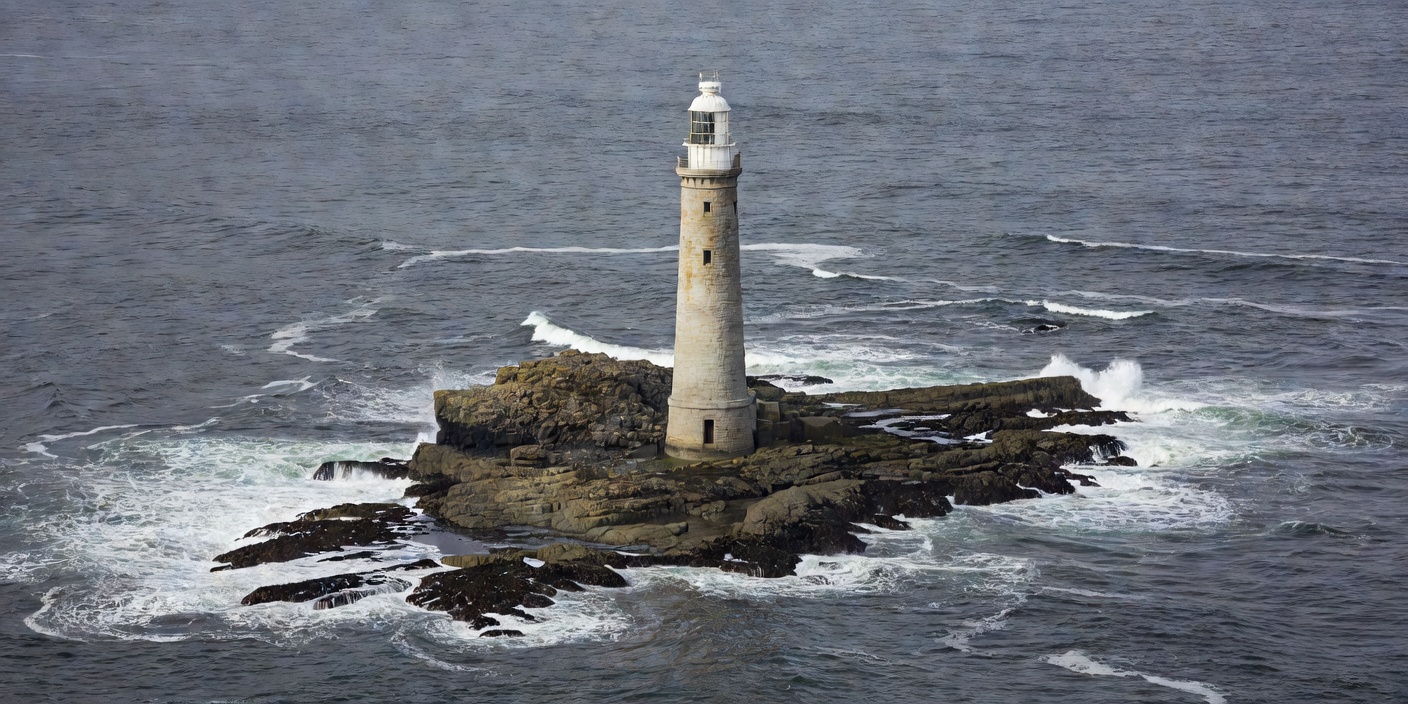
A reef with a working window
Bell Rock, also called the Inchcape Rock, lies off the east coast of Scotland near Arbroath. At high water the reef is submerged. At low water it offers a restricted working surface. A conventional shore building programme does not fit. The tide sets the length of a shift and interrupts work at the foundation itself.
Exposure matters independently of the tide. A low water level does not guarantee a safe landing. The construction system must accommodate both predictable immersion and less predictable sea conditions. Materials need preparation ashore. Each visit to the rock needs a clear purpose and a route back to safety.
Build the support system first
Robert Stevenson’s construction account gives the temporary beacon a central role. Its timber framework anchors to the rock and supports accommodation above the water. It supplies refuge and reduces repeated journeys between the reef and the attending vessel. Temporary works make the permanent works possible.
Shore facilities at Arbroath prepare and organise the stone. Blocks can be dressed and fitted before transport, reducing difficult work on the reef. This division is fundamental: precision belongs where tools, space and time are available. The offshore site receives components with known positions rather than rough material awaiting prolonged adjustment.
Lock the lower courses together
The tower follows the broad structural lesson of Smeaton’s Eddystone: a spreading base, a curved taper and connected masonry. Granite serves the lower structure; sandstone forms much of the upper tower. Shaped stone joints resist individual blocks being pulled or pushed out of position by moving water.
The lower part is solid masonry. Accommodation sits above it. This arrangement puts mass where resistance to overturning and displacement is most valuable. It also keeps occupied rooms away from the most direct wave action. The curved outline is not decoration applied to a cylinder. It distributes material and changes the surface presented to the sea.
Keep the engineering roles distinct
Bell Rock is closely associated with Robert Stevenson, the resident engineer responsible for the construction work. John Rennie also has a consulting role in its design history. Treating the project as an isolated act by a single inventor obscures the checks, decisions and practical organisation behind it.
The Northern Lighthouse Board provides the institutional setting. A lighthouse needs funding, tenders, vessels, stores and a continuing service after construction. Bell Rock’s importance lies partly in this combination: a demanding offshore structure supported by a shore-based organisation capable of maintaining it. The tower and its administrative system develop together.
From reflectors to refractors
The original optical arrangement uses oil lamps and parabolic reflectors on a revolving frame. A reflector redirects light from a source near its focus. This is a catoptric system: reflection does the concentrating. Red and white appearances distinguish the historical signal as the apparatus turns.
Later optical changes bring refracting equipment. A dioptric lens bends transmitted light rather than relying on a polished reflecting dish. Fresnel’s stepped construction reduces the thickness and weight required by a conventional large lens. These categories describe how light is gathered. They do not, by themselves, tell the observer the flash period, visible colour or range.
Automation changes the watch
Bell Rock’s transition to automated operation transfers routine supervision away from resident keepers. It does not remove the need for landing arrangements, reliable power or inspection. A remote alarm can report a fault. It cannot clean glass, replace a damaged fitting or make the sea suitable for an approach.
Compare Skerryvore. Both sit within the Northern Lighthouse Board’s responsibilities, and both require a shore-supported offshore service. Bell Rock’s distinctive construction constraint is the regularly submerged worksite. Skerryvore adds a different scale of Atlantic exposure and remoteness. Their similar silhouettes conceal different logistical demands.
Reference points
The Northern Lighthouse Board’s Bell Rock history provides the station sequence and the roles of the engineers. Robert Stevenson’s published An Account of the Bell Rock Light-House gives a detailed construction narrative. Read historical optical descriptions as historical specifications. For identification at sea, consult a corrected light list and the relevant notices to mariners.