A reference at the Atlantic edge
Fastnet lies off County Cork, beyond Cape Clear Island. Its position makes it a landfall reference and a warning of the rock itself. Those functions overlap, but they are not identical. A landfall light helps establish an approach from open water. A local danger still requires charted clearance, even when its lighthouse is plainly visible.
The Commissioners of Irish Lights provide the institutional thread through Fastnet’s development. Their remit extends around the island of Ireland. The station therefore belongs within an all-island system of aids, shore support and notices, rather than being read only as an isolated monument off the Cork coast.
The iron tower sets a limit
The first Fastnet lighthouse uses cast-iron construction, with internal masonry support. Iron offers prefabrication and relatively manageable components. It also requires attention to joints, corrosion and movement under exposure. Reinforcing an existing structure can improve it without removing every constraint imposed by its original dimensions and arrangement.
The granite replacement answers a broader brief than a change of material alone. It provides a substantial new tower and supports a more powerful optical installation. William Douglass directs the design for Irish Lights. This is not James Douglass’s Eddystone project, despite the shared surname and the close family connection within lighthouse engineering.
Fit the courses to the rock
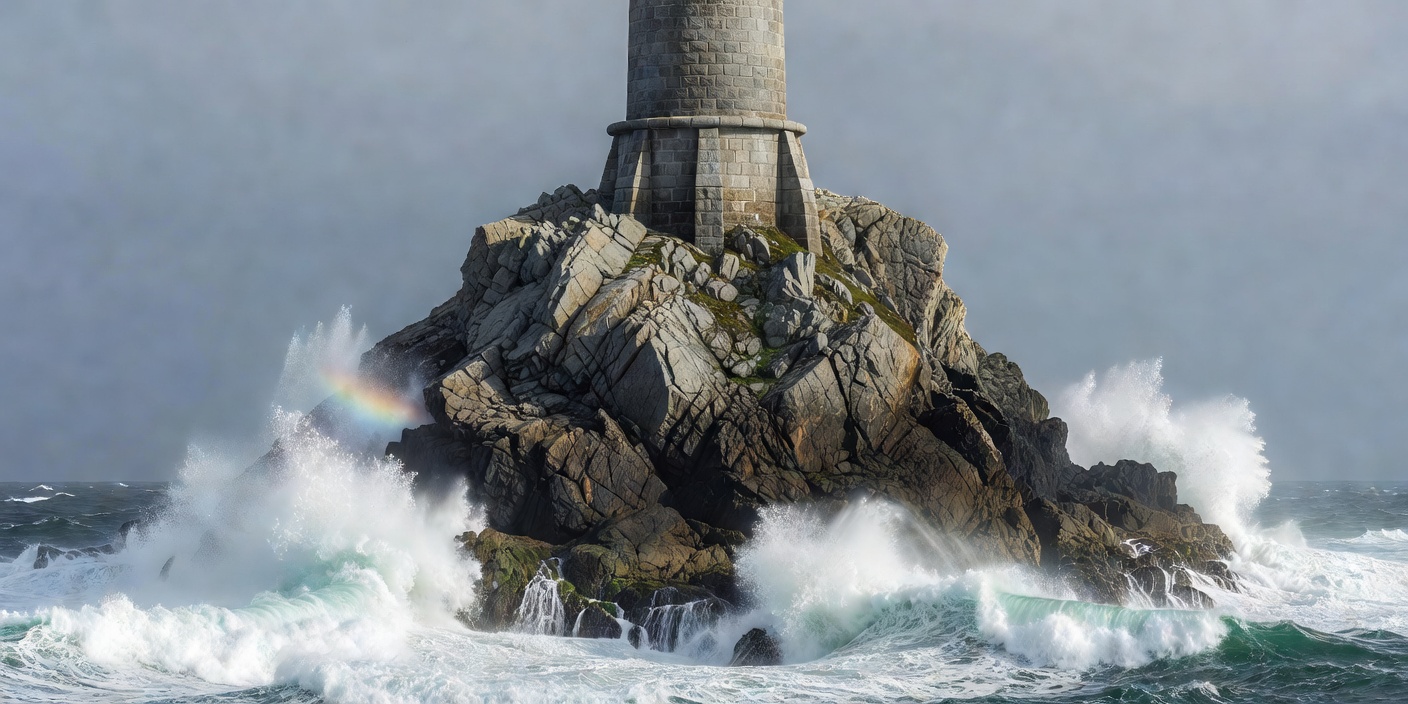
The replacement occupies a lower position on the rock than the earlier lighthouse. Its lower courses rise against the irregular outcrop before the complete circular shaft emerges. The foundation is therefore a carefully negotiated interface. It is not a flat disc placed on the summit.
Granite blocks use interlocking arrangements both within and between courses. Prepared stonework reduces the chance of individual movement and helps the tower act as an assembled mass. Accurate work ashore matters here as at Bell Rock. The rock receives blocks intended for particular positions, not interchangeable pieces that can be adjusted without consequence.
Sequence is part of stability
A complete tower can resist loads that a partly built course cannot. Fastnet’s construction requires temporary lifting equipment, secure landings and a sequence that keeps unfinished work manageable. Each delivery depends on the ability to transfer heavy material from vessel to rock. The quantity of stone is only one part of the difficulty.
Compare Eddystone. Its replacement responds to concerns beneath Smeaton’s masonry. Fastnet replaces an iron predecessor with a larger masonry solution suited to its setting and lighting requirements. Compare Skerryvore for the other side of the problem: granite, precise preparation and remote supply can produce a durable structure, but at substantial logistical cost.
Concentrate light before adding power
Fastnet’s granite tower is associated with a large first-order revolving optical apparatus. The lens collects light from the source and sends concentrated beams towards the horizon. Rotation produces the apparent flashes. A period describes the time taken for the visible sequence to repeat; it is not the duration of each individual flash.
The historical apparatus uses a mercury float to support rotation with low friction. That detail explains a mechanical solution, not a recommendation for handling mercury. Electrical conversion later changes the light source and supporting services. Lens, lamp, drive and power supply remain separate components, even when a station history groups them under “the light”.
Automation is an operating change
Automated operation removes the continuous resident watch from Fastnet. Irish Lights retains the tasks of monitoring, inspection and repair. Controls can detect certain faults and initiate a standby function. They cannot remove salt deposits or inspect every masonry joint. Reliability depends on the relationship between remote information and scheduled physical attention.
A lighthouse photograph cannot establish its operating characteristic. Nor does a historical range describe every state of visibility. Read Irish Lights’ operational information and relevant notices alongside a corrected chart. For comparison on this site, keep the durable features in view: Atlantic exposure, fitted granite foundations, optical concentration and a shore-supported maintenance system.
Reference points
Irish Lights’ Fastnet history provides the replacement sequence, engineering roles and lighting development. Its navigation material belongs to a different task: checking operational aids and changes. Keeping those sources separate prevents a familiar historical specification from being mistaken for passage-planning information.