The reef sets the terms
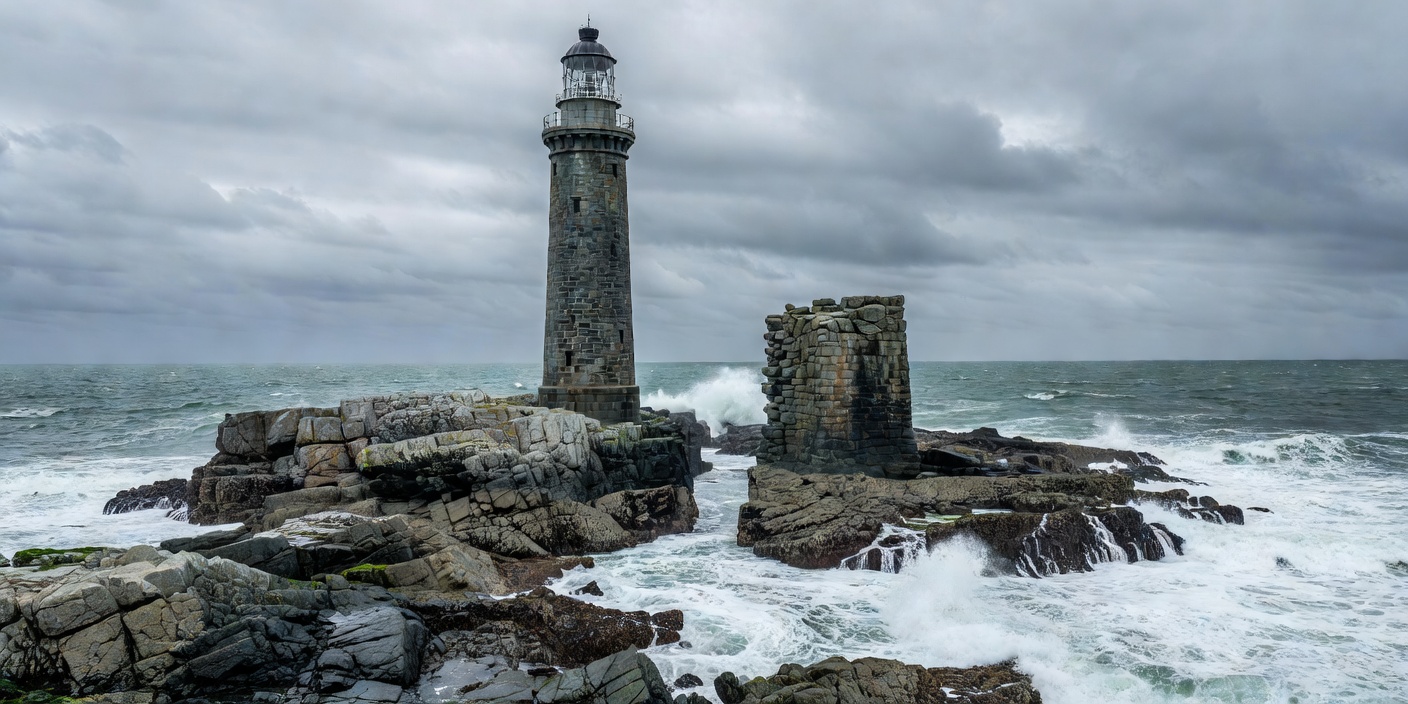
Eddystone stands on a group of rocks in the approaches to Plymouth. The hazard is not simply distance from land. Submerged rock threatens a vessel before the coast provides a useful visual reference. A light on the reef puts the warning beside the obstruction. It also puts the entire station within reach of breaking seas.
The site restricts landing, working time and the shape of a foundation. A design must survive incomplete as well as complete. Tools, materials and people cross an exposed landing before a permanent tower offers shelter. Construction logistics belong in the structural history, not in a footnote.
Different failures, different lessons
Henry Winstanley’s first tower uses an elaborate timber superstructure. A great storm destroys it. John Rudyerd’s replacement adopts a smoother, tapered profile and combines timber with stone ballast. Fire ends that tower’s service. The distinction matters. Resistance to waves does not establish resistance to an internal fire.
John Smeaton makes masonry the principal structure of the next tower. His profile draws on the spreading base of an oak. A broad foot narrows into a shaft. The comparison describes the form, not a claim that stone behaves like living wood. Weight, geometry and the connections between blocks do the structural work.
Make separate stones act together
Smeaton’s stonework uses shaped joints and fastening methods to resist displacement. Hydraulic mortar can set in wet conditions. Neither feature works alone. Carefully cut bedding surfaces transfer load; interlocking arrangements oppose sliding; the whole mass supplies stability. A lighthouse is not a pile held in place only by its own weight.
Breaking waves apply short, severe forces. A curved exterior offers fewer abrupt surfaces than a projecting façade. Yet a sound tower still depends on sound rock. Movement associated with the foundation beneath Smeaton’s tower drives the decision to replace it. Structural success and geological security are separate judgements.
Build beside the old foundation
James Douglass’s replacement places a larger granite tower on another part of the reef. Its broad cylindrical base supports the tapering shaft above. The upper part of Smeaton’s tower is dismantled and re-erected on Plymouth Hoe. The lower stump remains on the reef. The two remnants belong to different locations and should not be confused.
This is a useful comparison with Fastnet. Both histories include replacement rather than indefinite alteration. Eddystone’s decisive problem concerns the support beneath an established masonry tower. Fastnet’s replacement addresses the limitations of an earlier iron structure and the requirements of a more substantial Atlantic station.
Separate the lamp from the signal
Eddystone’s lighting history runs from candles through more concentrated oil lighting to electric equipment. A lens gathers light that would otherwise escape in unhelpful directions. A rotating arrangement sends concentrated beams past the observer. The visible result is a repeating characteristic, not a lamp physically switching off at every apparent eclipse.
That explanation applies to rotating optical systems. Other equipment produces flashes electrically. The operating mechanism and the observed rhythm are different descriptions. To identify Eddystone at sea, read the authoritative light list for colour, group and period. Historical lens descriptions do not establish the signal or equipment fitted for a particular passage.
Remove the resident watch, retain the work
Automation changes how Trinity House supervises Eddystone. Remote monitoring replaces continuous residence. Power supply, control equipment and access arrangements become central to reliability. A helicopter landing platform changes the tower’s silhouette and the maintenance route. It does not make every approach possible.
Compare Eddystone with South Stack. Both belong to Trinity House, but an offshore rock and an island below coastal cliffs impose different access constraints. Automation reduces routine occupation at both. It leaves inspection, corrosion control, optical cleaning and fault repair firmly in the physical world.
Reference points
Use Trinity House’s station history for the succession of towers, designers and lighting changes. Use official navigational publications for operational particulars. The most useful reading distinction remains simple: a history explains why the structure takes its form; a corrected light list tells a navigator what signal to expect.