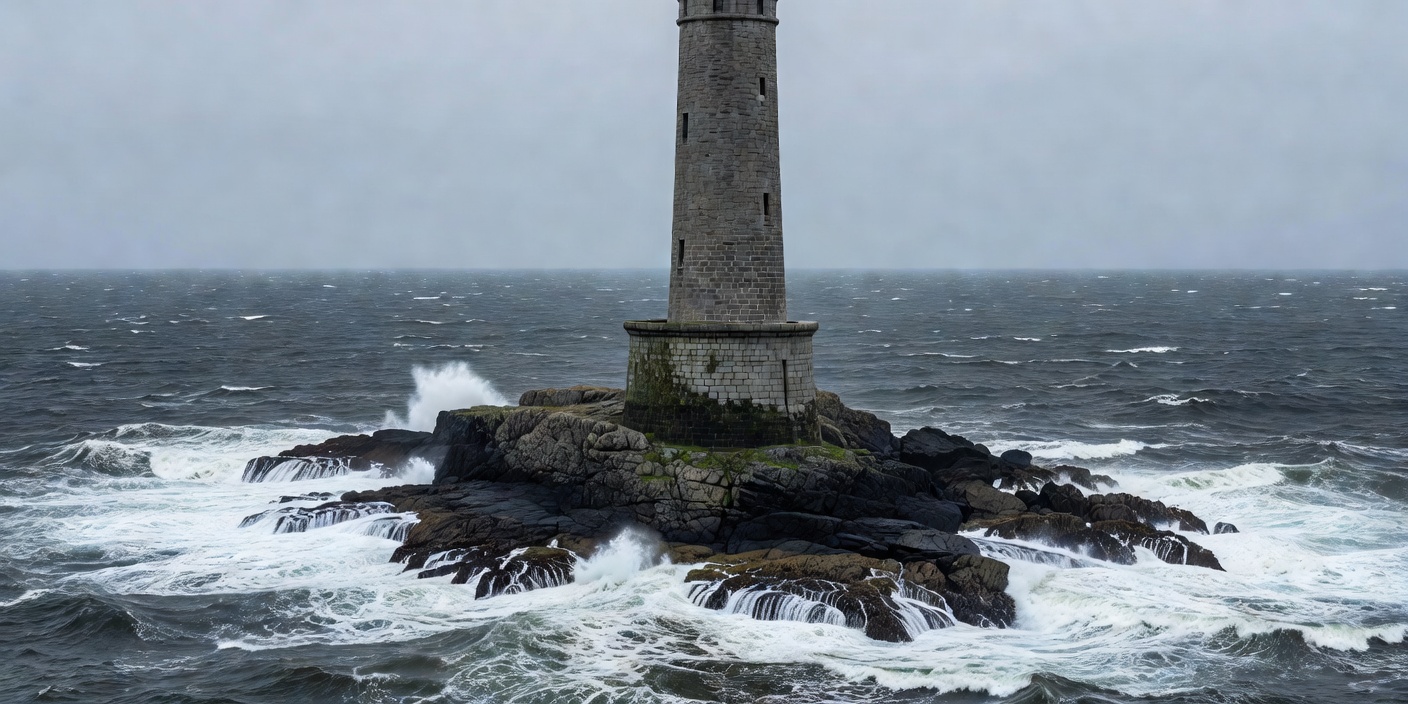
A hazard beyond the island
Skerryvore is a reef rather than an island with a sheltered building plot. Its rocks lie beyond Tiree in the approach from the Atlantic. A light there gives a vessel a reference close to a dispersed offshore danger. That position comes with a cost: almost everything required for construction and operation must arrive across open water.
The useful comparison is Bell Rock, not a conventional coastal tower. Both require a permanent structure on a small exposed foundation. Skerryvore’s setting places particular weight on the journey to the site, the security of temporary works and the limited opportunity to handle heavy stone safely.
The shore yard belongs to the tower
Alan Stevenson’s project depends on facilities at Hynish on Tiree. Harbour works, workshops and accommodation support the offshore construction. Granite is prepared through a supply chain that reaches beyond the reef. The visible shaft is the end of that chain, not the whole undertaking.
Accurate dressing and trial fitting reduce uncertainty at sea. A block with a defined position and prepared joints requires less adjustment after landing. This matters when lifting equipment, working space and time are restricted. The temporary barrack on the rock provides shelter, but its own vulnerability underlines the difference between a construction aid and the finished masonry tower.
The profile puts stone to work
Skerryvore’s lower body is solid. Rooms occupy the narrower tower above. The spreading base provides weight and a broad connection to the rock. The concave taper reduces the amount of masonry needed higher up while presenting a continuous surface to moving water. The shape is a structural allocation of material.
Granite brings durability and compressive strength. It also brings a large handling burden. Carefully fitted courses and connections between stones help the assembled tower resist disturbance. Increasing mass can improve stability, but every additional block must be quarried, shaped, transported and lifted. Offshore design cannot separate strength from the means of construction.
A large optic is not a large lamp
Skerryvore’s original lighting scheme uses a revolving first-order dioptric apparatus. “Order” describes the scale of the optical system through its focal distance. It is not a quality score. A first-order lens is a large assembly intended to collect and direct substantial light from a source at its focus.
Fresnel construction divides the lens into stepped elements. Refracting sections bend light towards the useful beam; prism arrangements can recover light from above and below the central lens. The resulting apparatus needs precise support and alignment. A powerful source placed badly within it wastes light and can distort the beam.
The rotation writes the rhythm
A revolving lens assembly directs its beams around the horizon. An observer sees a bright interval as a beam passes, followed by a darker interval. The characteristic describes that visible sequence. The period measures a complete repeat. Neither term identifies the fuel, lamp technology or machinery inside the lantern.
Range needs another distinction. Elevation extends the geometrical horizon. Intensity helps light remain detectable through the atmosphere. Haze can constrain visibility long before the horizon does. A larger optical apparatus therefore does not supply a fixed distance at which every observer can see the station. Published nominal range uses a defined atmospheric convention.
The structure outlasts its equipment
A major fire forms part of Skerryvore’s service history. Restoration and renewed lighting equipment show that a durable masonry shell can survive a much shorter cycle of internal systems. Fuel arrangements, electrical installations, lenses and controls require their own assessment. The tower’s age alone says little about the age of its light source.
Automation places supervision within the Northern Lighthouse Board’s wider monitoring arrangements. Maintenance still depends on physical access and shore support. Compare Fastnet’s substantial granite replacement: both demonstrate why the long-lived enclosure and its changing equipment need to be read separately. A familiar silhouette can contain a very different operating system.
Reference points
The Northern Lighthouse Board’s station history covers construction, optics, fire and automation. Alan Stevenson’s Account of the Skerryvore Lighthouse supplies the extended engineering account. For a useful comparison, read Bell Rock alongside it and follow the temporary works as closely as the finished towers. For navigation, obtain operational details from official light lists and notices.