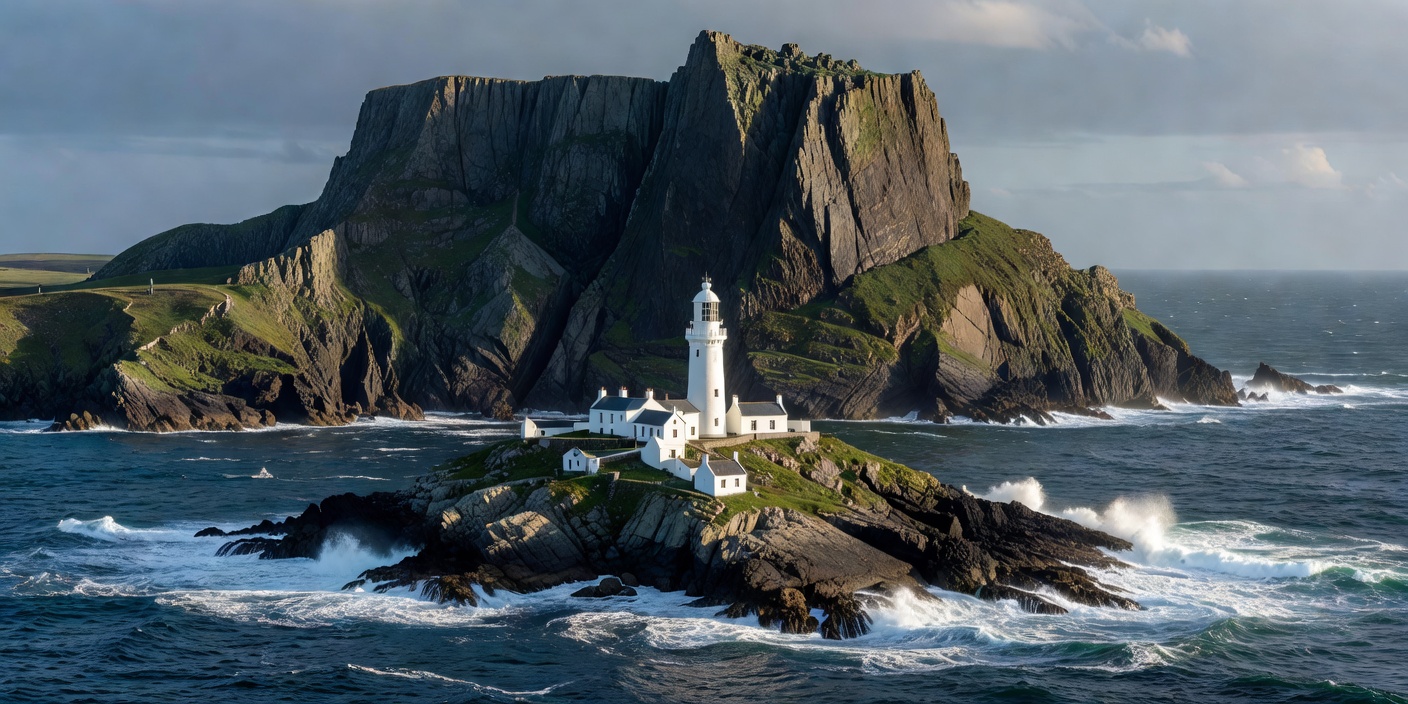
The site supplies part of the height
South Stack occupies an island off the western side of Holy Island, near Holyhead. Its light marks a prominent coastal turning point and supports approaches through the surrounding waters. Daniel Alexander’s station design belongs to a different setting from Eddystone’s sea-washed rock. There is room for associated buildings outside the tower.
The lantern gains elevation from both the island and the structure. This distinction prevents misleading comparisons. A short tower on high ground can place its light above a much taller offshore tower. Published focal elevation describes the light’s height above the stated sea-level reference, not the distance from the entrance to the lantern.
More elevation is not always better
Height can extend geographical range by moving the light’s horizon farther away. The observer’s own height also contributes. Atmospheric visibility remains a separate limit. Low cloud or mist can obscure an elevated light even when a lower part of the coast remains visible. Choosing a site therefore involves more than finding the highest available ground.
South Stack sits below the much higher coastal cliffs. Its arrangement makes the trade-off between elevation and visibility easy to recognise. It also shows why a photograph from the cliff top can mislead: looking down on the lantern does not mean that the light stands close to sea level.
Access is a structure of its own
A long stepped route descends the cliffs towards the crossing to the island. The bridge forms a distinct link in the station’s access system. Earlier crossing arrangements belong to the lighthouse’s development alongside the tower and optical equipment. The station may be close to land, but closeness does not remove a physical barrier.
Compare Bell Rock’s temporary beacon and Skerryvore’s shore facilities. Each answers a different access problem. South Stack depends on a descent and crossing rather than an entirely offshore transfer for every approach. Loads, tools and replacement equipment still need a practical route from the mainland side to the working station.
Spread the work beyond the shaft
At an offshore rock tower, storage and accommodation compete for space within a narrow vertical structure. South Stack can distribute functions among the tower and adjacent buildings. That allows a different internal arrangement. The masonry does not need to provide the same large solid wave-resisting foot as a tower built directly on a low reef.
Exposure still reaches the whole station. Salt affects metalwork. Water finds joints. External surfaces and the lantern require attention. The useful distinction is not “difficult offshore lighthouse” against “easy coastal lighthouse”. It is between different paths by which loads, moisture, people and equipment reach a structure.
Change the source, preserve identification
South Stack’s lighting history includes oil lamps with reflectors, later lens equipment and electric lighting. Reflectors gather light by reflection. Refracting lenses bend it into a useful beam. These changes improve the use of the source and alter the equipment that keepers must service. They do not make the navigational characteristic an optional detail.
A characteristic combines visible colour and rhythm. A chart abbreviation and a light-list entry describe that signal in a compact form. The repeat period is distinct from the duration of a bright interval. Equipment changes require official notification when they affect navigational particulars; an old visitor description is not a substitute for those notices.
Automation moves supervision ashore
Trinity House’s automation of South Stack removes the resident watch from routine operation. Monitoring and control become remote tasks, backed by visits for inspection and maintenance. The route to the island remains relevant because the physical apparatus remains there. A reported fault still needs diagnosis, suitable access and, where necessary, replacement parts.
Read the five stations together. Eddystone isolates the foundation problem. Bell Rock isolates the tidal work window. Skerryvore makes scale and supply visible. Fastnet shows comprehensive replacement. South Stack separates tower height from focal elevation and makes the access route part of the engineering. No single silhouette explains the whole lighthouse system.
Reference points
Trinity House’s South Stack history covers the station’s construction, crossing arrangements and lighting changes. Check official visitor information separately before planning access; a structural description does not establish opening arrangements or route suitability. For navigation, use corrected charts, a light list and notices to mariners rather than this architectural study.